
Why operator training goes wrong on the shop floor
Plant heads and L&D teams tell us the same four things.
Every trainer teaches differently
Without one standard, defect rates and rework go up from shift to shift and plant to plant.
The classroom has no machine
Trainees reach the line with theory but no muscle memory, and a slide cannot show what an interlock failure feels like.
The first weeks are the riskiest
Most machine mishandling and first-aid cases happen in an operator's first weeks on the floor.
Machines cannot stop for training
Taking a press or welding cell out of production to train one person costs output.
VR training or classroom training
Classroom and on-the-job training
- Theory first, the machine much later
- Quality depends on who is teaching
- First mistakes happen on the real line
- Needs a machine taken out of production
- Hard to prove who is ready
VR machine training
- The same machines, fixtures and SOPs, copied 1:1
- Every trainee gets the same steps, in Hindi, English or Marathi
- Mistakes happen in VR, with instant feedback
- No downtime: training runs in the training room
- A scored assessment before anyone goes on the floor
Modules we have built
Each module is built from your SOPs, work instructions and CAD data, so it matches the process on your line.
Stamping press operation
The end-to-end stamping process, from pre-operation checks to operation and inspection, with sequences of up to 54 steps.
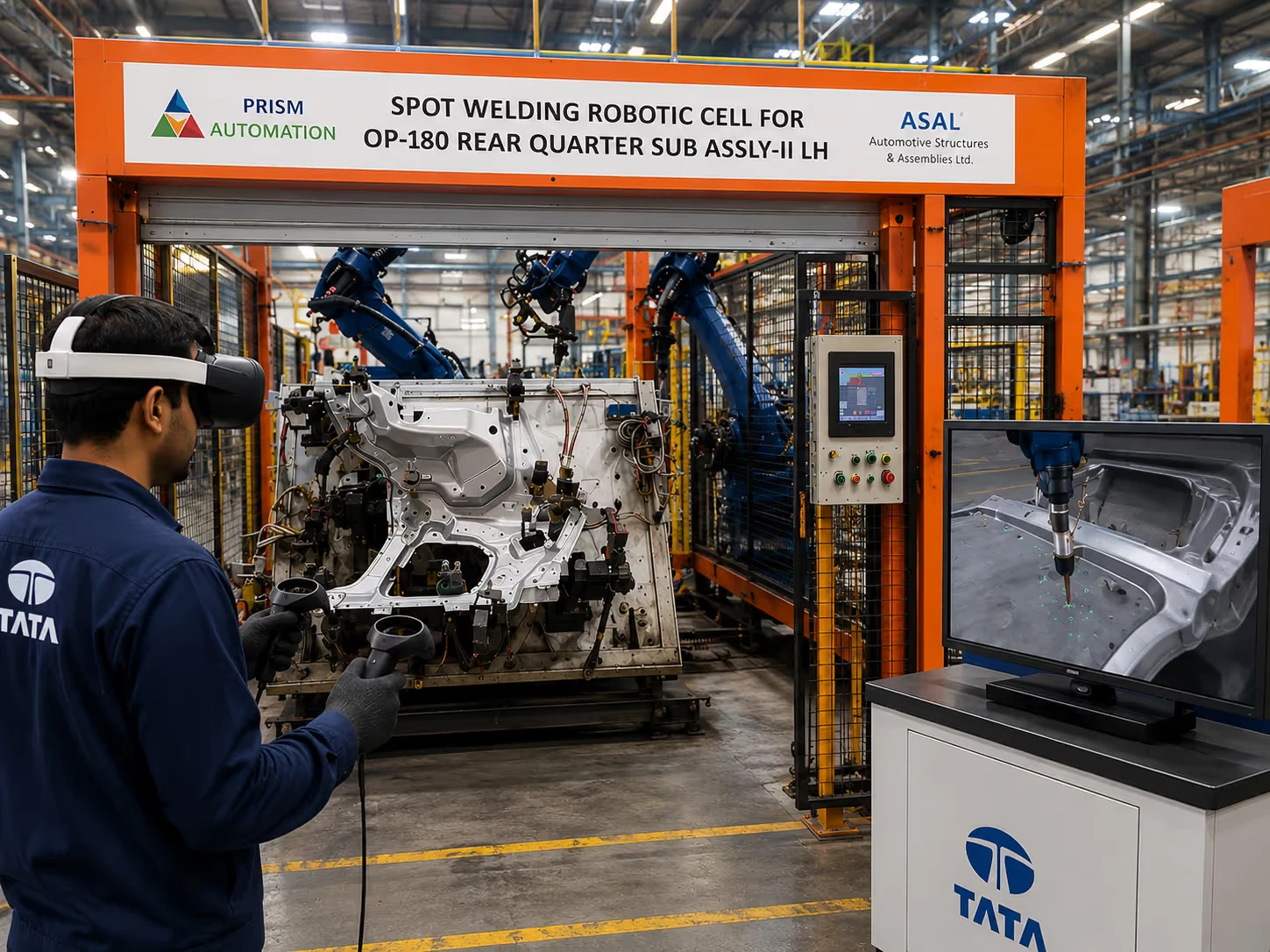
Robotic spot welding cell
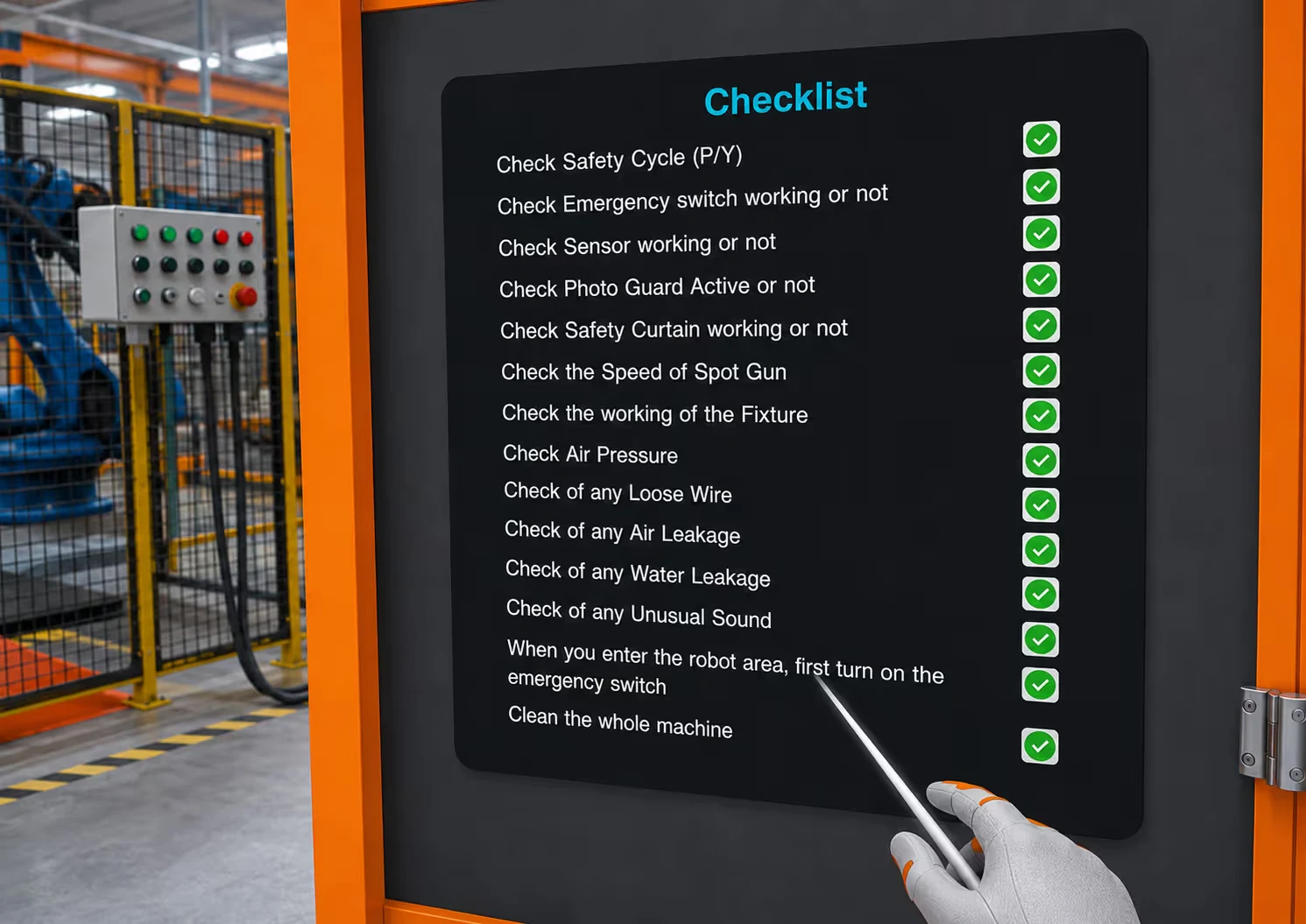
Safety, set-up, execution and quality checks at a spot welding cell, including the pre-start checklist and control panel.
Projection welding
Nut welding and the quality checks that go with it.
MIG welding
Manual welding practice, repeated as often as the trainee needs.
PPE and shop-floor safety
Choosing and wearing PPE, restricted zones and safe walkways. A trainee cannot continue without the right PPE.
Machine familiarisation
Control locations, interlocks and sensors, emergency switches and hazard zones.
Practise alone, then prove it
In guided mode, a voice and on-screen prompts take the trainee through every step, and the trainee practises on their own as many times as needed. In assessment mode the guidance is switched off. The trainee completes the process alone and is scored on sequence, errors and time.
Passing earns a VR completion certificate, which is required before going onto the shop floor. Supervisors see every result on a web dashboard with batch analytics and scorecards.
Your data stays inside your plant
We know IT and security teams sign off on training technology. The programme is built to pass that review.
On-premise, offline
Runs on a local server at each plant, behind the plant's own firewall. No internet is needed after set-up.
Private or public cloud
The same programme can be hosted on your private cloud over VPN, or on AWS, Azure or GCP.
Standalone headsets
Meta Quest 3 headsets with no PC needed, so the training can be rolled out to any plant.
ISO/IEC 27001
Metaverse911 is certified for information security management, as well as ISO 9001 for quality.
More training solutions
Frequently asked questions
What is VR machine training?
It is operator training on a 1:1 virtual copy of your machines and shop floor. Trainees put on a headset, practise each step of a real process such as stamping or spot welding, and pass a scored assessment before they work on the real machine.
Is VR training effective in manufacturing?
At a Tata Group company where our programme now runs across six plants, customer PPM fell from 329 to 100 and internal PPM from 2,000 to 500 after roll-out, and the cost of poor quality halved.
How much does VR training cost?
We do not publish a rate card, because the price depends on the number of processes, the number of steps in each and how complex the interactions are, plus the headsets and hosting you need. We scope each project after a plant visit.
Do we need PCs to run the training?
No. The modules run on standalone Meta Quest 3 headsets, so the training can be taken to any plant.
Can the training run offline, and is our data secure?
Yes. The programme can run fully offline on a local server at each plant, behind your own firewall, with data staying on the device or plant server. It can also be hosted on your private cloud over VPN, or on AWS, Azure or GCP.
Can the training be in our workers' language?
Yes. Voiceovers and on-screen text are produced in the languages your workforce speaks. The Tata AutoComp programme runs in Hindi, English and Marathi, with an icon-led interface.
How do we know a trainee is ready for the line?
Each process ends with an unguided assessment, scored on sequence, errors and time. Passing earns a VR completion certificate, and supervisors see every result on a web dashboard.