
Who this is for: marketing managers, product teams and plant heads who have CAD files or 3D renders of their products or machines and want them to run on a phone, a browser or a headset.
The business problem: models built for design are too heavy
3D models made for design or rendering are usually far heavier than real-time applications can handle. Every AR app, VR training module and digital twin depends on them. When the model is too heavy, you see six problems:
- Slow loading: this hurts web-based 3D viewers and VR, MR and XR applications most.
- Storage and hosting cost: smaller files need less storage and are simpler to manage.
- Compatibility: each platform has its own requirements for 3D content, and lighter models are easier to fit to them.
- Limited devices: heavy assets need a lot of memory and processing power, so they only run on powerful PCs.
- Poor mobile experience: smaller downloads work better on phones and low-bandwidth connections.
- Slow rendering: lighter models render faster, which matters in games and simulations.
Doing the work by hand is also slow. A junior artist who is new to the software may not know how to optimise a detailed model at all. An experienced artist can still spend a long time reducing and exporting a single asset while a deadline closes in. Many immersive technology companies outsource this step instead, and then an urgent change depends on someone else's response time. Either way, the project loses time and money.
Why the gap exists
Artists and designers often build very detailed models. That is right for rendering and design review. Real-time applications such as AR viewers, VR training and digital twins need lighter versions. Reducing the polygon count, simplifying geometry and optimising textures lets the same model render smoothly on a wider range of hardware. This matters when a 3D experience has to work on a phone or in a web browser as well as on a powerful PC. An optimisation tool closes the gap between content creation and real-time use. Bringing 3D assets into real-time use is otherwise an iterative process, held back by complex software, platform limits and a lack of consistent guidelines.
What the Convrse.ai 3D Model Optimizer does
The tool was built by Convrse.ai, a separate company. We introduced it at a LinkedIn Live session with the Convrse.ai team, "Elevate Your Tech: 3D Asset Optimization Tool for Tech Leaders". It uses mesh decimation, texture compression and LOD (level of detail) generation. Convrse.ai says it can reduce file size and polygon count by up to 80% while preserving visual quality. That figure is the tool's own claim. Results will depend on your model.
Vikrant Singh, Founder and CEO of Convrse.ai, describes the tool as a bridge between 3D content creators and real-time engines. It helps optimise earlier work and guides creators through new workflows. It is compatible with major file formats and with platforms such as Unity, Spatial and Roblox. Rrahul Sethi, our founder, has used it to optimise assets himself and found that it removed most of the friction from the workflow.
Convrse.ai also states that uploaded 3D models are permanently deleted after optimisation, so no client data is stored. If your CAD files are confidential, ask for this in writing before you upload anything.
What the AI does to a scene
- It cleans the whole 3D scene and removes redundant meshes.
- A segmentation layer identifies the types of object in the scene and optimises each by its geometry: animations, fluids, organic shapes, humanoids and hard surfaces.
- It marks important vertices on each surface so the shape is preserved.
Features that save time
The features below come from the two Convrse.ai sessions we hosted. Most of them answer one question: where is the model heavy, and how much detail can you give up without the viewer noticing? The heat map and the viewer help you see this. Selective and batch optimisation help you act on it across many files.
- File conversion: converts 3D files into more than 30 formats, so models work across different software.
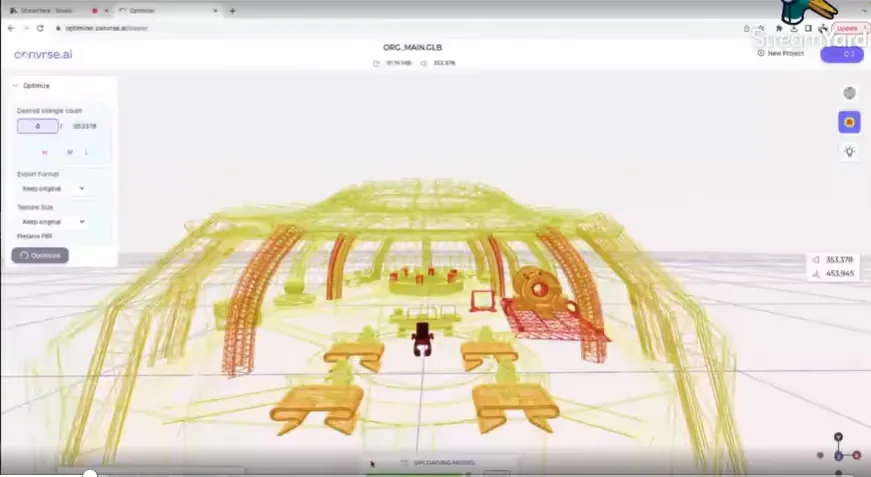
- Heat map and mesh analysis: an interactive heat map shows where a complex scene is heaviest, with suggestions for improving the mesh.
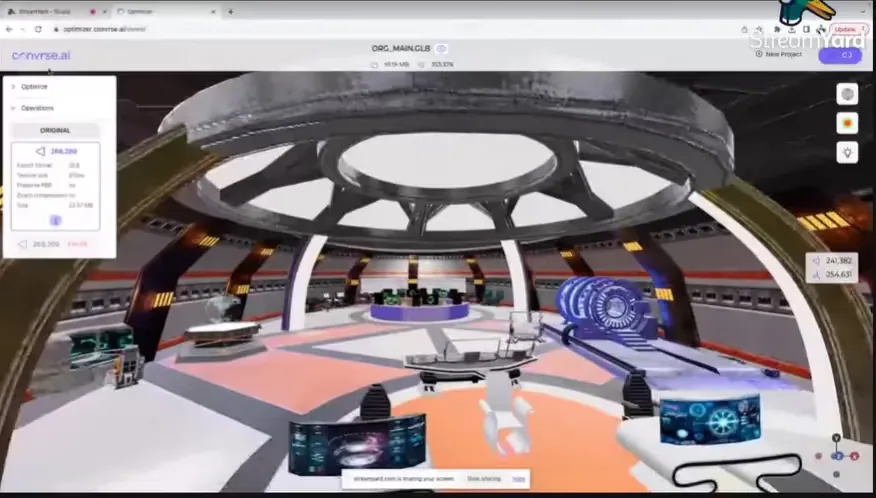
- 3D viewer and editor: an inspector tool lets you adjust the scene in real time and check the result before you export.
- Remeshing, retopology and UV unwrapping: complex meshes can be remeshed, and the tool then unwraps and bakes textures onto the new mesh automatically.
- CAD file support: prepares and optimises CAD data for real-time 3D, which matters for anyone starting from engineering drawings.
- Selective optimisation: optimise single assets or groups, and decide where to keep detail and where to save on performance.
- Batch optimisation: upload large projects with many files and get a notification when processing is done.
- 3D file management (3D CMS): a personal dashboard to manage optimised models and publish them. Scene management clears out old and unused projects.
Where lighter models help
Convrse.ai lists these areas. For a manufacturer, the first and third are the most relevant.
- Digital twins and industry: faster real-time simulations for product visualisation, digital prototyping and equipment simulation. In aviation, automotive and manufacturing, that means more efficient training simulations and more precise equipment planning.
- XR: better real-time rendering for VR virtual tours, interactive storytelling and architectural walkthroughs.
- Architectural visualisation: interactive walkthroughs, interior design simulations and furniture layouts.
- 3D visualisation: customers can explore products in 3D, from virtual showrooms to interactive product views.
- Gaming: smooth gameplay in detailed open worlds, with less motion sickness.
What to do, step by step
For a manufacturer, the starting point is usually a set of CAD files for products or machines. These steps keep the work simple:
- List the models you need first. Pick the product you show most often at exhibitions or in sales visits.
- Decide which parts must stay detailed, such as a control panel or a branded surface, and which can be simplified. The heat map and selective optimisation make those choices visible.
- Sign up and create an account on the tool, then drag and drop your 3D file.
- Set the polygon target, export format and texture optimisation, then click optimise. Convrse.ai says the model can be ready within 30 to 60 seconds.
- Check the result in the 3D viewer, then export to the format your AR, VR or web viewer needs.
- For a large project with many files, use batch optimisation and wait for the notification that processing is complete.
- Remove old or unused projects from the workspace so the team works on current files only.
What a real example shows
The examples in this guide come from Convrse.ai and from our LinkedIn Live sessions, not from a Metaverse911 client project. The one use we can report first hand is Rrahul Sethi's own: he optimised assets with the tool and found the workflow much easier. The practical point for a plant or a marketing team is the same. Product CAD files can be turned into light, real-time models faster, which shortens the path to an AR product viewer, a VR machine demo or a digital twin, and makes later changes cheaper.
Light models are also what a 3D product configurator runs on. A buyer can then change options on a touch screen without waiting for the model to load.
If you want light models put to work, we build AR product visualisation and 3D product configurators from your CAD files.
A note on expectations
Optimisation does not replace design judgement. A control panel, a logo or a branded surface may need to stay detailed, while a hidden internal part can be simplified a lot. Treat the first run as a test. Compare the optimised model with the original in the 3D viewer, adjust the polygon target, and run it again if needed. Keep the original CAD file safe, because you will want it for the next version of the product.
Next step
If you want to adopt the 3D Model Optimizer, or need your CAD models turned into real-time 3D content, talk to our team and we will connect you with the right people.
First published on the Metaverse911 blog.

Frequently asked questions
How can you reduce 3D model file size without losing quality?
Use mesh decimation, texture compression and LOD (level of detail) generation. The Convrse.ai 3D Model Optimizer combines these techniques with AI. Convrse.ai says the tool can cut file size and polygon count by up to 80% while keeping visual quality. That figure is the tool's claim. The AI cleans the scene, removes redundant meshes and marks important vertices so shapes are kept.
Why do 3D models need optimising for AR, VR and web viewers?
Models made for design or rendering are usually far heavier than real-time applications can handle. Lighter models load faster, cost less to store and host, are easier to fit to each platform, need less processing power and memory, and run more smoothly on mobile and low-bandwidth connections.